 |
| One of the many gobsmacking fruit displays at La Boqueria |
Well let me tell you, friends and neighbors, she was right. She was right about Barcelona being an amazing city in general, and she was spot-on about La Boqueria. It's an immense market in the heart of the city, ranked by CNN as one of the top 10 markets on the planet, and on an initial visit, it's sheer sensory overload. The sights, the sounds, the smells... I just pointed my Nikon and clicked indiscriminately, probably with my mouth hanging slightly agape the whole time. I was incapable of anything more than the most basic of reconnaissance on the first visit. More on La Boqueria later, though.
Barcelona was the companion destination on my European escape which began in Paris. (Or perhaps it should be the other way around, as I spent more time in Barcelona than in Paris!) I booked travel on the high-speed French TGV train from Paris, a service which just began in December 2013, and arrived at Barcelona-Sants station just six comfortable hours later. There, I made my way to what was a very nice "home away from home" for the next five nights. I was most fortunate to be offered a corporate-owned luxury apartment in which to stay. At some 1,800 sq ft, it was of course much too big for just one person, but it was oh-so-comfortable nonetheless. It was particularly beguiling in the mornings, as I would cook my breakfast, make a cup of coffee with the French press, and look out over the adjacent park at sunrise. The apartment was in easy walking distance to the park, the zoo, the whole of the Born District, the harbor and beach of the Mediterranean, and much more, including La Rambla, the most famous street in the city.
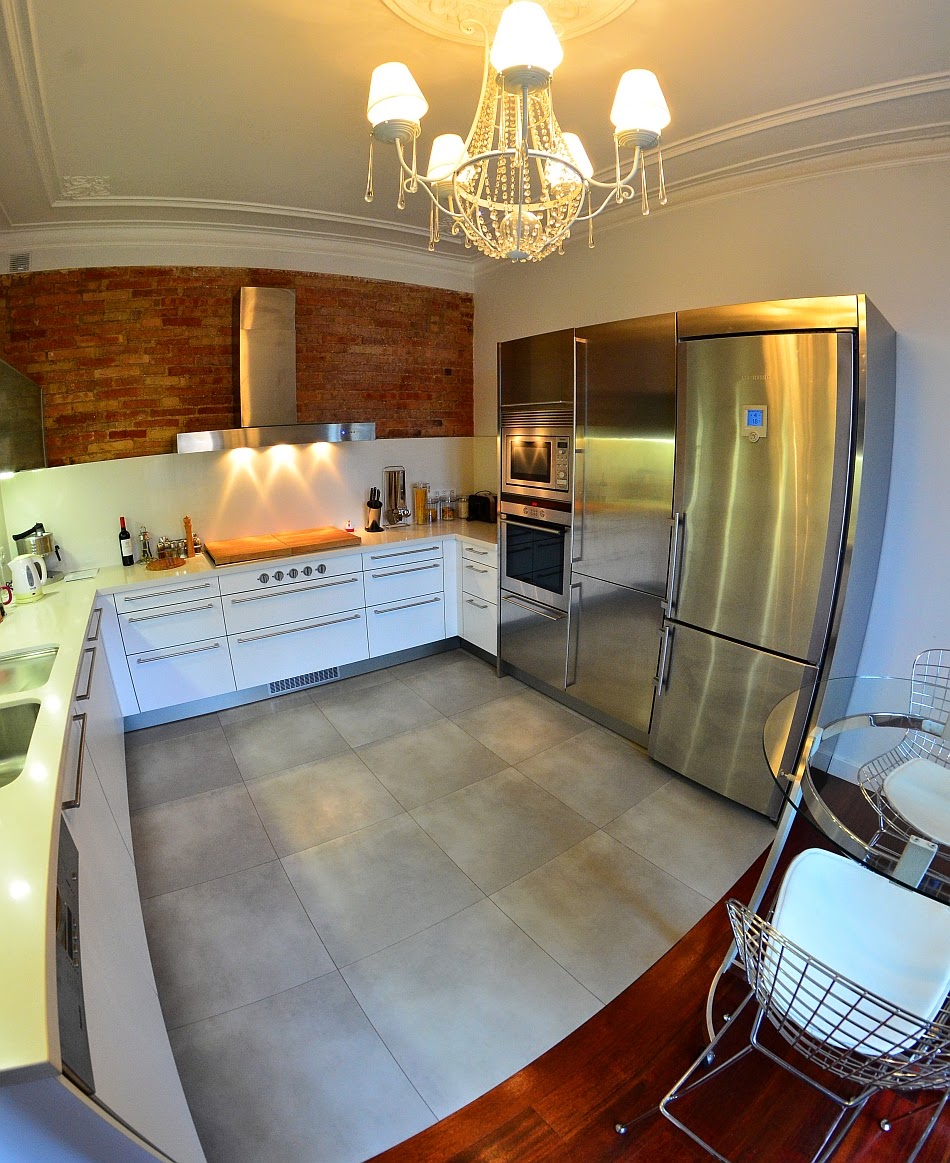 |
| My kitchen for a week! Nice, right? |
 |
| Here's the dining area and the living room |
 |
| The master bedroom... probably the only thing I didn't care for was the rather out-of-place animal pelt on the floor |
 |
| Exposed brick, big timbers, and top-quality fixtures and fittings... loved the master bathroom! |
 |
| This was the bedroom I didn't use... just walked in, snapped a picture, and that was that! |
 |
| A truly beautiful, comfortable place to have as my base |
 |
| This was the fiery sunrise over the park one morning, snapped from the apartment's kitchen |
 |
| And this was my morning ritual... Really a nice way to start the day! |
I was quite unaware of Barcelona's incredibly rich historical tapestry, going all the way back to the third century (and even further back, really), encompassing Catalonia and Iberia, and sweeping in such well-known names as Christopher Columbus and Antoni Gaudí along the way. I took a fascinating walking tour (Sandeman's New Europe tour) on a perfect sunny day with a sky so blue it almost defied belief, had an outstanding guide, met some great new people, and learned tons, most of which, unfortunately, was promptly forgotten. A particularly astute historian, I am not. I also made a booking for their excellent tapas tour, which took place later during my stay. One treat was seeing a couple of impromptu circle dances in front of a beautiful cathedral. The dance is called the sardana and it's deceptively complex, employing a highly structured pattern of moves and rhythms, set to a particular style of music played by a small 12-piece ensemble called a cobla, comprising 10 wind instruments, a double bass, and a small drum called a tamborí. The 12 instruments are collectively played by only 11 musicians, so I'm not sure who ends up doing double duty, but it was a remarkable cultural moment to happen upon. I do think the ensemble on hand for what we saw was more of a mini-orchestra, however, as they had brass instruments, and I don't believe a traditional cobla has these.
The cathedral in front of which all this was taking place is gorgeous, a 14th-century gem built in honor of the co-patron saint of Barcelona, a young virgin named Eulalia who was martyred in the 4th century, but whose absurd tale didn't manage to get dreamed up and recorded until some 800 years later. The story, certainly fictional, goes that this 12-year-old girl was subjected to 13 separate tortures for her steadfast refusal to renounce her Christianity, including being flogged, placed in a barrel with knives and/or glass and rolled down a hill, doused with boiling oil, covered in molten lead, and several even more gruesome acts. In a medical miracle, the young girl survived all of this and was thrown into prison, where she was (of course) later freed by an angel. If all this doesn't suggest that the story is at least partly fanciful, consider the fact that it's almost identical to another patron saint, this one of Mérida, and in both stories, a dove was involved. In the Barcelona tale, the dove emerged and flew from the girl's neck upon her decapitation, which of course took place after her crucifixion (which she apparently survived, as well). In the Mérida tale, the dove flew out of the girl's mouth at the moment of her death. Macabre, right? Amazing what you can learn on these walking tours! Anyway, we all had a bit of a chuckle (apparently no devout Catholics in our group), enjoyed the genuinely incredible architecture, and left it at that!
 |
| Barcelona's stunning Cathedral of the Holy Cross and Saint Eulalia, built primarily in the 13th and 14th centuries with a neo-Gothic façade |
 |
| A small orchestra called a cobla was playing traditional Catalan dance music on the day of our tour |
 |
| A traditional (and complex) Catalan circle dance called the sardana. Why does the woman facing the camera look so miserable, though? Maybe she's struggling to remember all the steps correctly! |
 |
| This was interesting: graffiti in the city was virtually always limited only to the shutters of shops, never on the adjacent buildings themselves |
 |
| I wasn't kidding about the blue sky! |
 |
| A typical apartment building in the Born District |
 |
| The 1884 statue of Antonio Lopez y Lopez, the first Marquis of Comillas |
 |
| Our knowledgeable and riotously funny guide Leon, far right, regales us with a lengthy and humorous poem of his own composition at the conclusion of our walking tour |
The weather in Barcelona was markedly different from what I had experienced in Paris. Though the temperature wasn't all that much higher (usually low to mid-50s, or around 10-12°C), there was plenty of bright sunshine and an abundance of clear blue skies, which made it much more enjoyable. In fact, it only rained one day out of the six I was there. One day, about midway through my stay and after I had developed enough confidence in my ability to navigate the neighborhood successfully, I made my way to the beach nearby and enjoyed strolling along the Mediterranean under a brilliant blue sky lashed with cirrus clouds. Mind you, it was still nowhere near "warm" in early February, and most of the trees were bereft of any foliage, but a blue sky and a sunny day makes everything better, and even with a jacket and scarf on, it was good to be on the beach! Later, on the walk back to the apartment, I stopped by a Greek restaurant (of all things) and had some great food... flavor-packed lamb and beef gyros, a bit of souvlaki, some pita bread, and a short pint of crisp Mythos, a pretty decent Hellenic pale lager from Greece's second-largest brewery, you know... just across the Med!
 |
| The zoology museum of Barcelona, called the Castel dels Tres Dragons in the Parc de la Ciutadella |
 |
| Another building at the park... really no idea what this one is and cannot seem to find any information on it |
 |
| Barcelona's immensely popular and successful bicycling initiative, sadly for residents only |
 |
| The Barcelona Arc de Triomf, built for the 1888 Universal Exhibition |
 |
| Street scene, with people enjoying the mild midwinter day |
 |
| Note the tree laden with oranges |
 |
| No idea what building this is, but I loved the architecture |
 |
| The park is home to many hundreds of these Monk parakeets |
 |
| Angry Birds! The population of feral Monk parakeets is thought to number about 2,500 in Barcelona |
 |
| The park's large fountain, Cascada, designed by Josep Fontserè and his young, then-unknown student Antoni Gaudí |
 |
| A café in the Gothic District all ready for evening diners |
 |
| The entrance to the apartment building where I stayed |
 |
| Emblazoned on the tapas bar's window seems to be the key to Barcelona's immense appeal: Drink. Food. Life. |
 |
| This one was nice... not far from the apartment and great happy hour specials. On the sign to the left of the door: Todo hecho casero y con mucho amor, basically saying everything here is homemade with love. |
 |
| Again, not really clear who this is, but I liked the photo op. Fun fact: the popular belief that the pose of the horse indicates how its rider died is, in fact, false |
 |
| Another appealing café in the neighborhood, readying itself for evening business |
 |
| The attractive Port Vell (which means "Old Harbor"), little more than a derelict railroad warehouse area before an urban renewal program in the run-up to the 1992 Olympics gave it new life |
 |
| A stand-up paddle boarder (yes, it's a thing) meanders by on the blue waters of the Med |
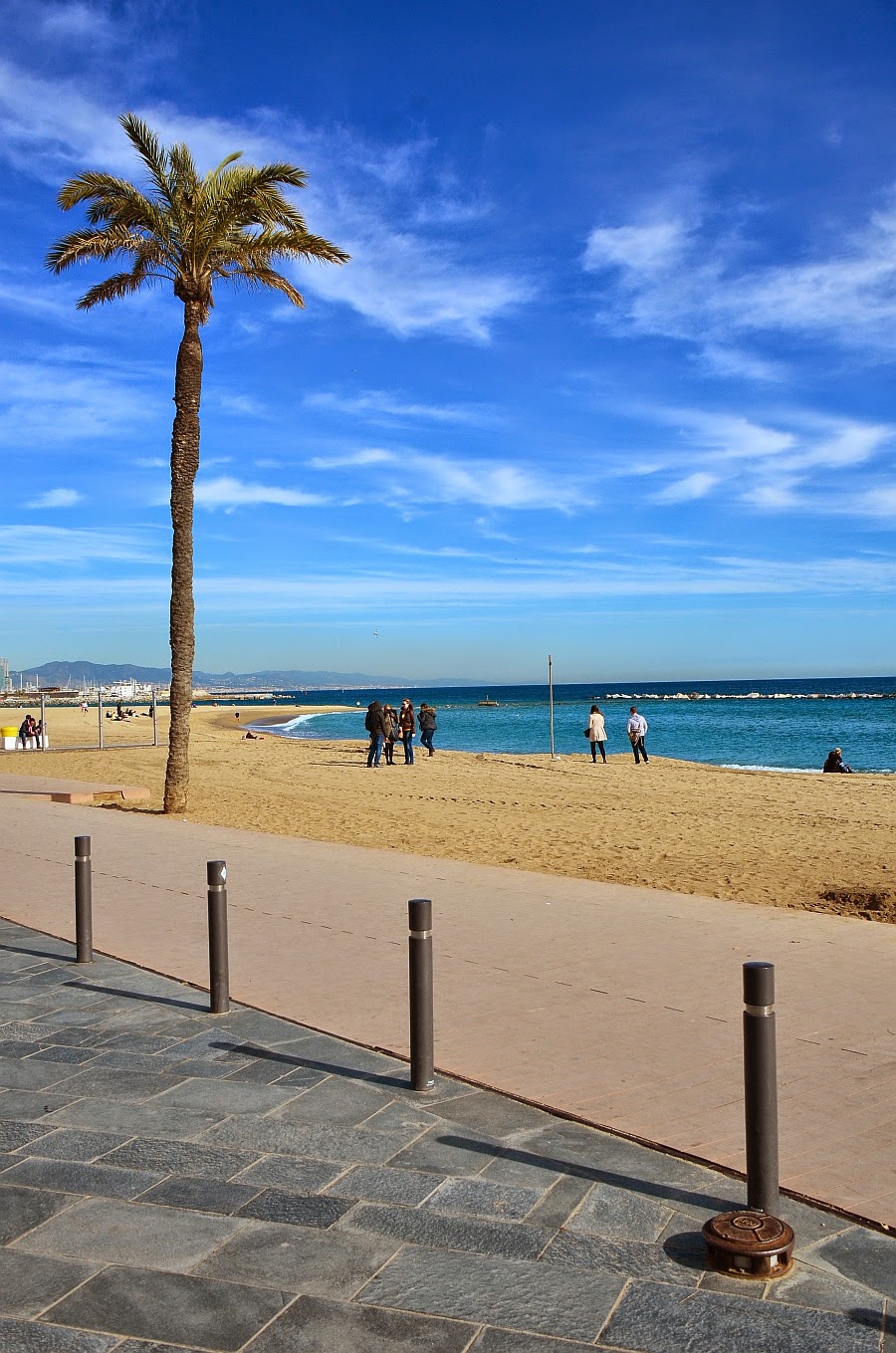 |
| Artistic clouds lace the sky over the boardwalk by the sea |
 |
| A funky blend of luxury, heritage, design, and color at Port Vell |
 |
| Hola! The incomparable jamón Ibérico |
Second, the animal is allowed to spend the last few months of its life grazing on an open plain punctuated by oak trees, a field called the dehesa. The Ibérico pig loves acorns and can eat some 20 pounds a day running around and foraging in the dehesa, so in just three to four months before being slaughtered, the pig can double its weight, adding some two pounds of fat per day. The acorn-rich diet of the pig's last few months is second only in importance to the specific breed of the pig for the resultant magic of the finished product.
Third, there is an exceptionally long curing process in which the fatty legs are packed in a volume of sea salt determined by the leg's weight, allowed to rest in the salt for a few weeks, then hung to dry in the cool mountain air, typically for two to four years. During the long curing period, the legs lose about half their weight as the fat slowly drips away. Because of the salt and the antioxidant quality of the pig's diet of acorns (the acorn is the bellota referenced in the name of the final product), bacteria cannot attack and spoil the ham. The fats break down and recombine several times over, the ham dries ever so slowly, and a symphony of uniquely complex flavors develops.
Once the process is finally complete, the result is a deep red ham with wonderful marbling that literally melts in your mouth. In fact, because of the extraordinarily high content of fat marbling in the ham (surprisingly, most of which is monounsaturated), it will melt a bit at any temperature above about 75-78°F, so the fat melts away as the thin slices of ham rest on your tongue and the exquisite flavor of the cured meat develops, mingling with the rich flavor of the fat. For porcine aficionados, there is nothing like it, and as you might expect, Ibérico de bellota doesn't come cheap. Ham from those acorn-fed pigs is usually at least twice as expensive as a normal Ibérico ham, and exceptional strains which have been aged longer, classed as "reserva" or "gran reserva" (much like Spanish Rioja wine), can cost even more (think $70-100 per pound if you're buying the whole leg, which is usually 12-15 pounds). But like the finest Kobe beef or Beluga caviar, this is a delicacy that, if afforded the opportunity, you should sample at least once – being well aware that even a few thin slices can set you back a handful of euros!
 |
| How much is that piggy in the window? Well, that depends on whether it's a white-pig Serrano, a black-pig Ibérico fed on corn, or a black-pig Ibérico de bellota fed on corn and acorns... get your wallet ready! |
 |
| With apologies for the garish color of the display lights in the case, this is a fine way to sample Spanish hams |
So when I wasn't eating Serrano, Ibérico or my other favorite, the smoky, spicy chorizo (which is altogether different than Mexican chorizo, by the way), I was wandering the streets of the Born District and neighboring Gothic District, never getting too far from the apartment, but in all honesty, never needing to. I have found that, at least for me, when traveling, it's preferable to explore one area with more depth and fullness than to see a lot of places, but truly experience none of them. Each philosophy has its own appeal and merits, but Barcelona needs to be embraced, not just skated over. I spent time in the outstanding 70-acre park next to the apartment (Parc de la Ciutadella), met plenty of people (locals and visitors alike), and despaired over my mediocre abilities in conversational Spanish going largely for naught, as everyone in Barcelona tends to speak Catalan. I had been looking forward to being able to decipher signs and such, but most of those are in Catalan, too.
 |
| So basic, yet so awesome: a fresh baguette layered with slices of Serrano ham, drizzled with Spanish olive oil, and served with a generous glass of Spanish tempranillo... just €4 at Enrique Tomas café |
 |
| A similar dish recreated at the apartment, yet looking very much like something at a café... except the entire bottle of wine was only half the cost of the meal in the previous photo! |
 I stumbled onto La Boqueria the first time almost by accident. I made my way to La Rambla, and as it was the only rainy day on the trip, found myself briskly walking from store to store in an attempt to avail myself the brief use of their canopies and overhangs. It was a fine, misting sort of rain, and I had an umbrella with me, but apart from a few moments of actual light rain, the drizzle didn't really demand an umbrella. And suddenly, I looked up and, across the street, there it was, somewhat unassuming under a fairly unexceptional signed archway: Mercat de Sant Josep de la Boqueria. I wandered in and was, in short order, in full sensory meltdown. There aren't sufficient words to really describe this market, so just look at the photos. It's an absolute orgy of flavors, smells, and colors... a veritable beehive of food-focused activity. I've been to some pretty amazing markets, but nothing like this. From fruit to meats to chocolates to nuts to marzipan to cheeses to vegetables, La Boqueria has more food that you can imagine. Fresh food, prepared food, baskets of food, artistically arranged piles of food... wines and beers, fresh juices, sparkling cavas, all complementing plates of Spanish olives, marinated mushrooms, chorizo, and jamón. I've never seen its equal. If you go to Barcelona, quite plainly, you will be genuinely missing out if you don't see (and experience) La Boqueria.
 |
| Biggest strawberries I've ever seen were at La Boqueria |
 |
| A blizzard of nuts... roasted, candied, salted, flavored, you name it |
 |
| What fun! Fresh food, including yummy salchichón (Spanish sausages), and plenty of beer and wine |
 |
| The vegan's nightmare continues |
 |
| Colorful marzipan and choco-goodies |
 |
| Mustn't forget your veggies... |
 |
| Grab a cup of fruit for some power noshing while you shop! |
 |
| Salchichón, chorizo, jamón Serrano, jamón Ibérico... it's porkapalooza!! |
 |
| Another great way to sample a selection of Spanish meats |
 |
| Do I really have to just settle for one?? |
 |
| A marvelous mélange of peppers |
 |
| What the hell is all this? Who knows? Dried mushrooms, infused oils, what looks like nonpareils... just anything and everything |
 |
| Fruits, chilies, and spicy sauces, including the pride of Avery Island, Louisiana... Tabasco! |
 |
| Bring your own insulin |
 |
| Do I buy stuff here or just marvel at how beautifully it's all arranged!? |
 |
| Great café. Note Ms. Pink Hair inside! |
 |
| Ah, the sign of "there was still hope" |
 |
| A decidedly local grunge bar serving up cheap San Miguel beer and... |
 |
| A truly splendid burger whose true glory isn't at all well-captured in this hasty camera-phone snap |
The next night, we gave the tapas tour another go and this time, a fair few of us showed up, including people from Australia, the US (besides me), New Caledonia, Mexico, South Africa, and continental Europe. It was great. We bounced from tapas bar to tapas bar, sampling a myriad of dishes, drinking wines and beers, and sharing stories and getting acquainted. One particular place saw our guide instructing us in the use of the porró, a glass wine pitcher in Spain, though we had one – or maybe two – filled with beer, too, accompanying the two holding wine. The porró looks like a glass watering can with a very narrow spout, tapering to almost nothing. The idea is that you can fill the pitcher with a wine (a full bottle), then pass it around in a group, as you can drink from the thing without the spout coming in direct contact with your mouth. We all tried it, with varying degrees of success and errant dribbles here and there, and by the time we got to our fifth venue and started swimming around in their large and excellent mojitos, we were all well and truly feeling no pain. It was a fun night, and for me, the only downside was that it was indeed my last night in Barcelona, so I had to get back to the apartment and pack everything up for an early departure the next morning, so I didn't get to close down the bars with the rest of the gang, but did manage to hang around until nearly midnight.
 |
| The tapas tour begins! |
 |
| Crazy eights! Sober and reserved at tapas bar #1... but it was a rather different tale a few hours later! |
 |
| Brave potatoes! The ubiquitous patatas bravas, perhaps the quintessential Spanish tapa. And no, it doesn't really mean "brave potatoes"! |
 |
| I think this was venue #3, and with three or four full porrós of wines and beers to share, the fun really began in earnest here |
 |
| Our fearless off-duty Catalan guide seizes a porró and shows us how it's done |
 |
| Nine people collectively representing five continents; by midway through the evening, we had all gotten plenty chummy! |
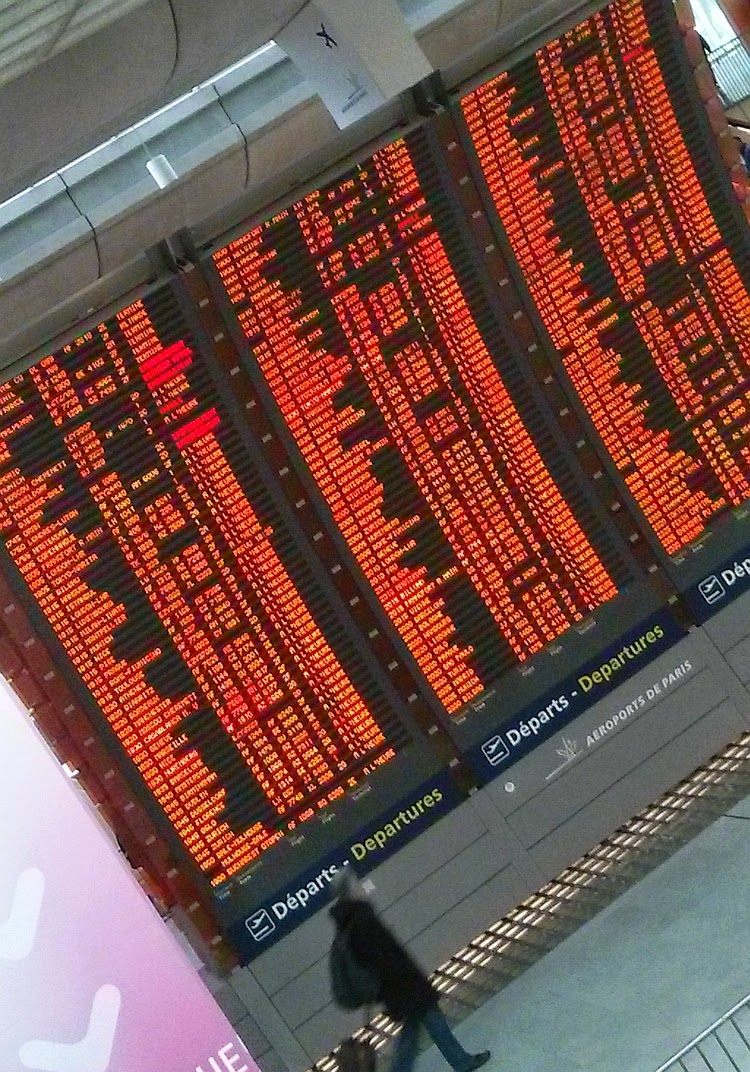
I woke up early the next morning, showered, had a small "eat on the go" brekkie, and put the finishing touches on my packing. I made my way to the nearby Metro station, bags in tow, and took the train to Barcelona-Sants to kick off the first leg of the trip back to KL. In actual fact, the journey back was really a great part of the overall vacation. Again, I took the high-speed train, this time in the first-class car back to Paris (not as impressive as it sounds; it was only like €10 more than the regular car), and the weather was excellent, so I enjoyed great views of the Pyrenees mountain range and the picturesque towns and farms of Spain and France along the way. Of course, I grabbed a fresh baguette, a bottle of cheap Catalonian wine, and some delicious Serrano ham before leaving Barcelona and once again had a very nice meal on board the speedy train as the scenery whizzed by. I don't know what most of the towns and buildings are in the photos I snapped, so just enjoy the relatively information-free scenics!
 |
| Various meats and cheeses... the entire contents of that pack of Serrano ham ended up in the middle of the baguette :) |
 |
| Stuffed to the gills! There may or may not have been a half dozen bottles of various French and Spanish wines ensconced in my bag |
 |
| The upper deck of the first-class car on the TGV |
 |
| The Pyrenees Range in northeastern Spain |
 |
| Farmland in the valley |
 |
| A Spanish town near the French border |
 |
| Looking vaguely Pikes Peak-ish, Mt. Canigou forms an impressive backdrop |
 |
| Mt. Canigou, 2,784 m/9,134 ft. |
 |
| And this is where that Serrano ham found a home... so yummy! |
 |
| This is a pretty picturesque town, right? Not a bad place to hang your hat |
 |
| Pastoral countryside in the south of France |
 |
| How I got a shot like this through a window while traveling at nearly 200 mph is a mystery to me |
 |
| The mountains give way to gently rolling pasture in France |
 |
| And one of my favorites, a patchwork of deciduous and evergreen forests, intermixed with different shades of green fields |
 |
| The first glass in my personal airborne wine tasting! |
 |
| A decent effort at a mushroom and wilted spinach risotto, served with a splendid glass of premier cru Chablis |
 |
| The battery on my Nikon actually died after the risotto shot, so I was relegated to using my phone to snap this shot of the herringbone seat layout of Etihad's Abu Dhabi–KL flight |
 |
| On departure from Abu Dhabi, it's hard not to notice the enormous Ferrari World theme park, all under a vast 2.1 million sq ft roof |
 |
| Smoked duck breast? For me? How kind! |
So that concluded my somewhat whirlwind nine-day vacation to Paris and Barcelona. I assumed this would wrap up my long-haul travel adventures for at least a little while, but I was wrong. Shortly after getting back to work in early February, I was offered the work-related chance to visit New Zealand in April... and who could pass up a great opportunity like that? Not me, that's for sure. Stay tuned... that's the next entry!


.jpg)


